What this entry found
- CONFIRMED
the "past two weeks" reports refer to an aggregate trend period (roughly early-to-mid August 2026), which precedes and contextualizes the single-day snapshot…
Checked against Haaretz.the document
- OUTLETS DISAGREE
Whether Iran's control was 'completely' lost or 'partially' lost
- bastillepost.com (at least partially lost)
- voi.id (at least lost some)
- ONLY ONE OUTLET HAD THIS
voi.id carried 4 details no other outlet reported.
- A month before the recent two-week period, almost no ships used the Omani route
- Dan Pickering, founder and chief investment officer of Pickering Energy Partners, said many in the Middle East don't want to pay Iran's toll levy
- Iran and Oman have been discussing the future of shipping in the Strait of Hormuz for the past few weeks
- A draft agreement between Iran and Oman regulates ships entering the Arabian Gulf through Iranian-controlled routes and exiting through Oman-controlled routes, with service fees for security and environmental protection
Shipping traffic through the Strait of Hormuz has shifted toward the Omani southern route, with over 80 percent of vessels in recent weeks choosing that passage over Iran's preferred northern route. The change reflects broader instability in the waterway following US-Iran conflict and Iran's failed attempts to collect tolls from transiting vessels.
Who reported it
- bastillepost.comUNCLASSIFIED
- dw.comPUBLIC
- middleeasteye.netUNCLASSIFIED
- voi.idUNCLASSIFIED
References
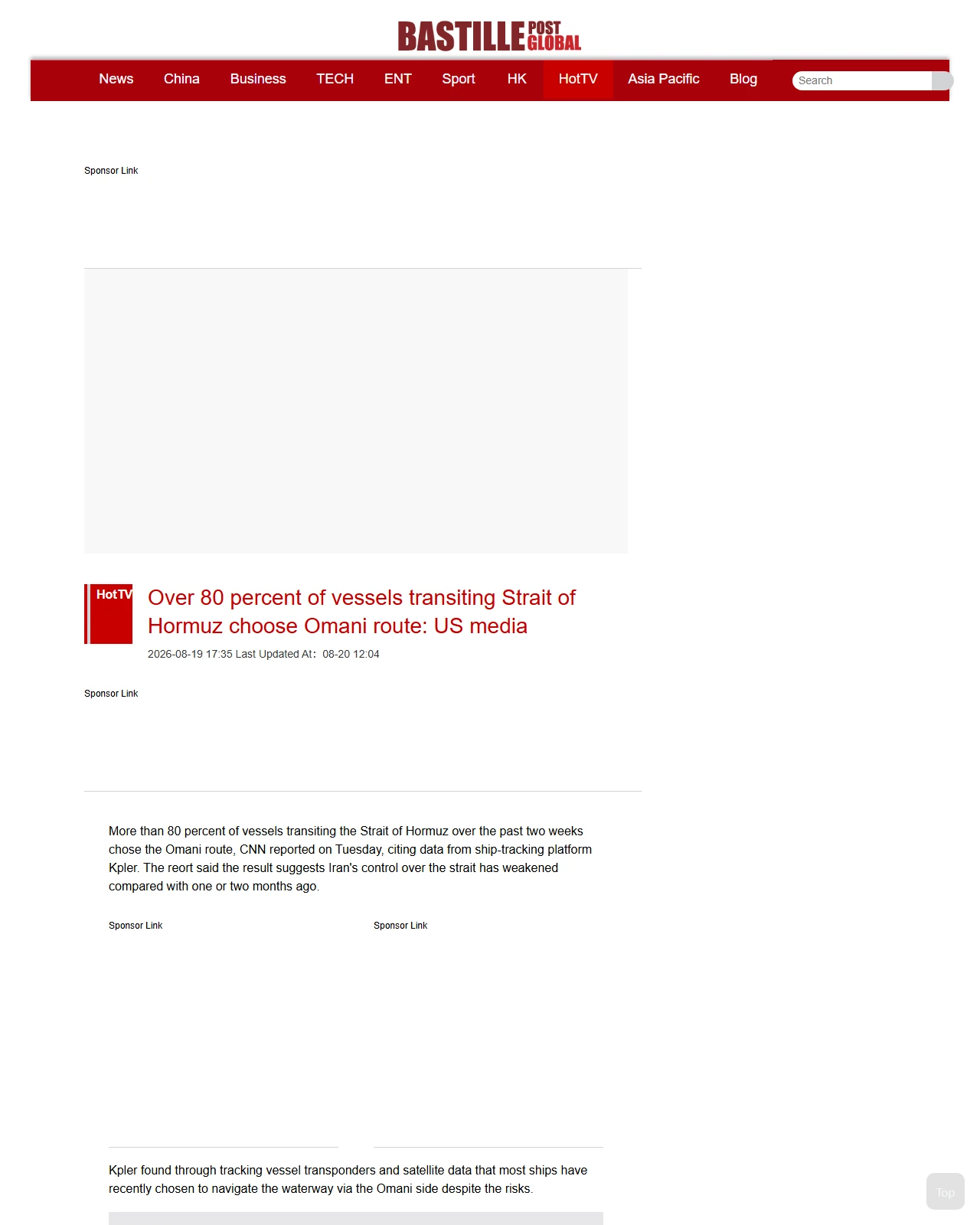
- bastillepost.comOver 80 percent of vessels transiting Strait of Hormuz choose Omani route: US mediaScreenshot as publishedOriginalcaptured 2026-08-20T11:17:13
- dw.comAs US-Iran war rages, who's risking the Strait of Hormuz?Screenshot as publishedOriginalcaptured 2026-08-03T18:43:54
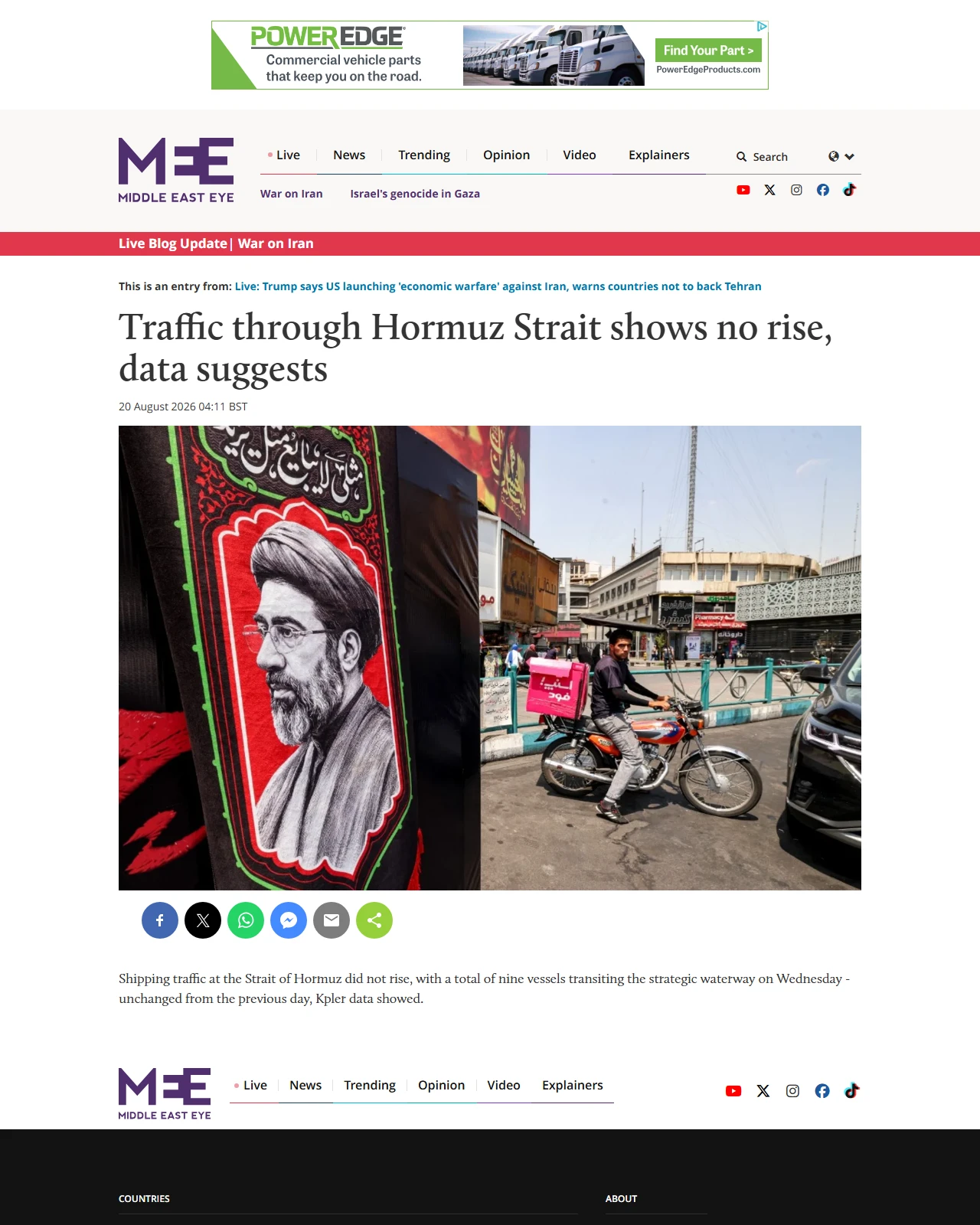
- middleeasteye.netTraffic through Hormuz Strait shows no rise, data suggestsScreenshot as publishedOriginalcaptured 2026-08-20T11:17:13
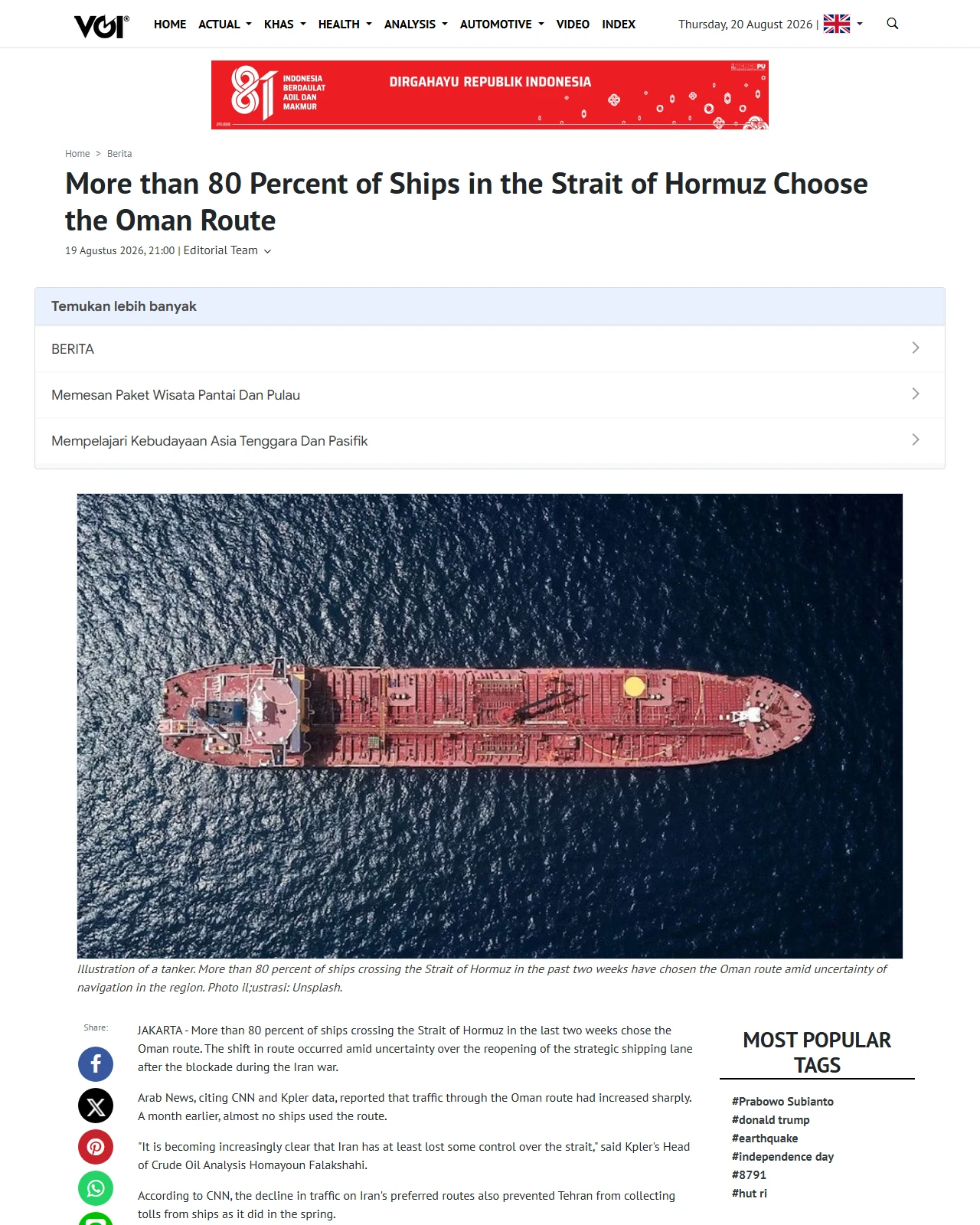
- voi.idMore than 80 Percent of Ships in the Strait of Hormuz Choose the Oman RouteScreenshot as publishedOriginalcaptured 2026-08-20T11:17:13
Carried by multiple outlets
- More than 80 percent of vessels transiting the Strait of Hormuz over the past two weeks chose the Omani routebastillepost.com, voi.id
- Kpler (a ship-tracking platform) provided data on vessel routing patternsbastillepost.com, dw.com, voi.id
- Homayoun Falakshahi, head of crude oil analysis at Kpler, stated that Iran has lost at least partial control of the straitbastillepost.com, voi.id
- Iran's inability to collect tolls from passing vessels resulted from the shift in routing away from the Iranian-controlled northern routebastillepost.com, voi.id
- A US-Iran memorandum of understanding signed in mid-June opened the strait and created an Iranian-controlled northern route and Omani southern routes with US military navigation assistancebastillepost.com, dw.com
- Conflicts between the US and Iran resumed over control of the strait after the initial reopeningbastillepost.com, dw.com
Reported by one outlet only
- Iran's Parliament's national security and foreign policy committee passed a bill on March 30 to charge vessels transiting the straitonly bastillepost.com
- Iran announced the closure of the strait again after conflicts resumedonly bastillepost.com
- On 20 August 2026, a total of nine vessels transited the Strait of Hormuz, unchanged from the previous day, according to Kpler dataonly middleeasteye.net
- A month before the recent two-week period, almost no ships used the Omani routeonly voi.id
- Dan Pickering, founder and chief investment officer of Pickering Energy Partners, said many in the Middle East don't want to pay Iran's toll levyonly voi.id
- Iran and Oman have been discussing the future of shipping in the Strait of Hormuz for the past few weeksonly voi.id
Reported unevenly
- The temporal scope of when Iran began attacking shipping vessels and the status of the strait being 'closed'stated by dw.com · absent from bastillepost.com, voi.id, middleeasteye.net
- Whether Iran's control was 'completely' lost or 'partially' loststated by bastillepost.com (at least partially lost), voi.id (at least lost some)
Not yet confirmed against a primary source
- Confirm the publication date and timeframe for dw.com's article: the byline reads 'July 28, 2026' but the cluster is dated 20 August 2026. Verify whether this is a rerun or an error, and whether the 'past few weeks' references in the article align with 20 August as the reference date for the cluster.
- Verify whether the 'past two weeks' referenced by bastillepost.com and voi.id overlaps with or precedes the single-day snapshot (9 vessels) reported by middleeasteye.net on 20 August 2026. These may describe different time periods with different baselines.
What was checked, and against what
2 of 2 confirmed against a primary source. Every document is linked so you can read the same record we did. Anything not confirmed is listed as such rather than left out.
- checked Confirm the publication date and timeframe for dw.com's article: the byline reads 'July 28, 2026' but the cluster is dated 20 August 2026. Verify whether this is a rerun or an error, and whether the 'past few weeks' references in the article align with 20 August as the reference date for the cluster.DW.com · establishes that the outlet published it · The August 19, 2026, publication date is accurate for the Nord Stream arrest story, and the "July 28, 2026" byline is a technical glitch on the dw.com dw.com/en/welcome-to-dw-beta-pages-a-new-version-of-the-dwcom-website/a-53807770. The article's reference to the "past few weeks" aligns with a mid-to-late August 2026 timeframe, as the suspect's arrest was announced on August 19, 2026. · 2026-08-20
- checked These may describe different time periods with different baselines.Haaretz · establishes that the outlet published it · Yes, they describe different timeframes and metrics: the "past two weeks" reports refer to an aggregate trend period (roughly early-to-mid August 2026), which precedes and contextualizes the single-day snapshot of 9 vessels reported on August 19–20, 2026. · 2026-08-20