What this entry found
- ONLY ONE OUTLET HAD THIS
qz.com carried 9 details no other outlet reported.
- Goolsbee spoke at an event in London
- Goolsbee argued that oil prices hovering near $100 a barrel following the war in Iran and repeated tariff escalations constitute sustained supply shocks that can no longer be dismissed as temporary
- Goolsbee stated 'It's going to be painful. It would necessarily be painful' to reporters after his speech
- Goolsbee said the only way back to 2% inflation is 'the hard way'
- Goolsbee's position puts him at odds with Fed Chairman Kevin Warsh
- Goolsbee stated: 'This is exactly the painful trade-off between employment and inflation that stagflationary shocks always impose on a central bank'
- Goolsbee argued that monetary policy works by reducing demand rather than boosting supply
- Goolsbee acknowledged that the Fed's response to supply-driven inflation need not be as aggressive as its response to demand overheating
- Goolsbee warned that restoring price stability requires compressing demand enough that employment and wages fall to match the economy's reduced supply capacity
Federal Reserve Bank of Chicago President Austan Goolsbee spoke at an event in London, stating that bringing inflation down to 2% will require economic pain and job losses, since monetary policy reduces demand rather than supply. He argued that supply shocks from oil prices and tariffs cannot be treated as temporary.
1 of 4 articles were readable. Headline only, no body text retrieved, for: bloomberg.com, boereport.com, reuters.com. Nothing below is drawn from those outlets beyond their headline.
Who reported it
- bloomberg.comWIRE
- reuters.comWIRE
- boereport.comUNCLASSIFIED
- qz.comUNCLASSIFIED
References
- bloomberg.comFed’s Goolsbee Says Road to 2% Inflation May Not Be PainlessScreenshot as publishedOriginalcaptured 2026-09-21T14:34:58
- reuters.comFed's Goolsbee says strong demand may be adding to US inflationScreenshot as publishedOriginalcaptured 2026-09-21T14:34:58
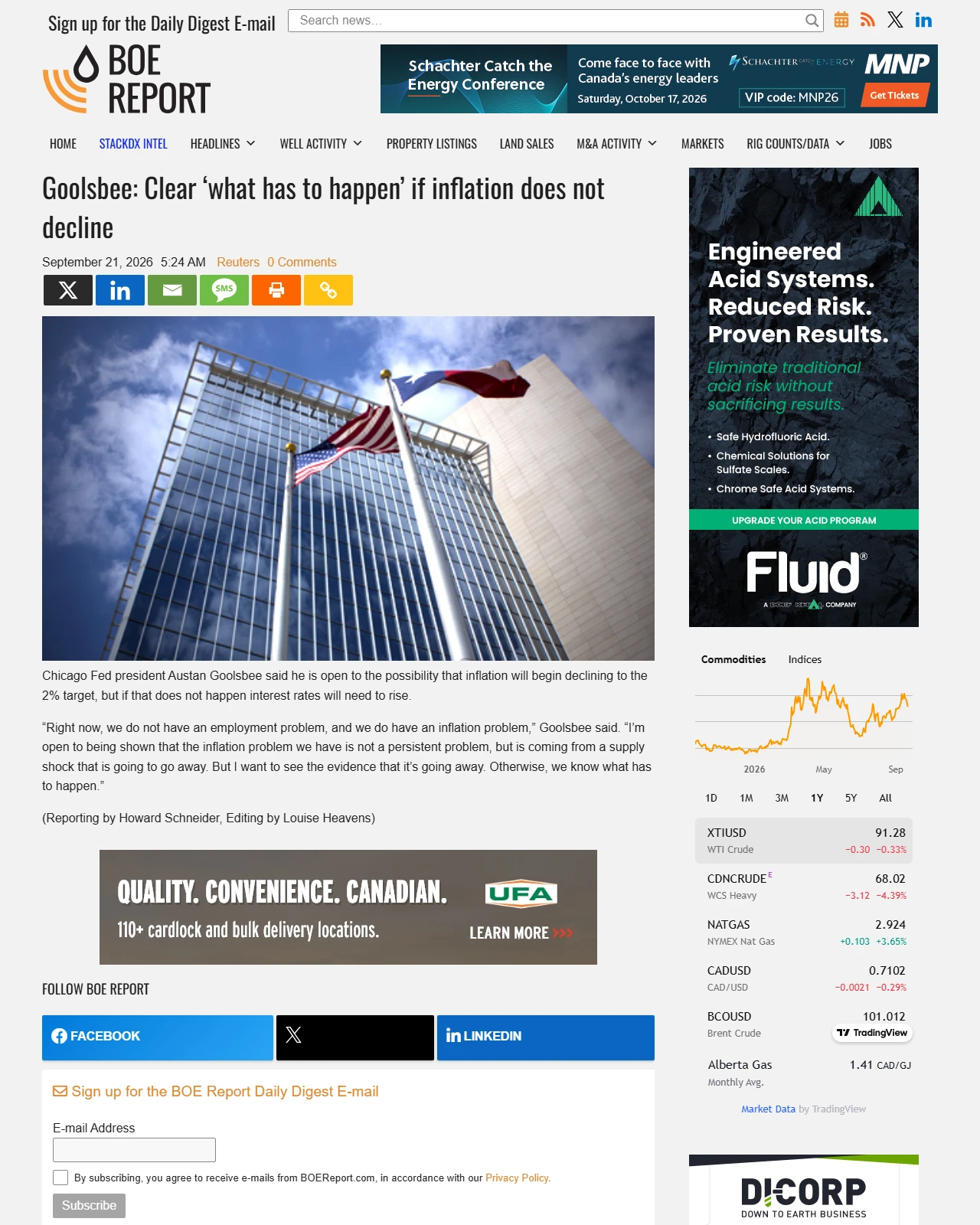
- boereport.comGoolsbee: Clear ‘what has to happen’ if inflation does not declineScreenshot as publishedOriginalcaptured 2026-09-22T16:51:52
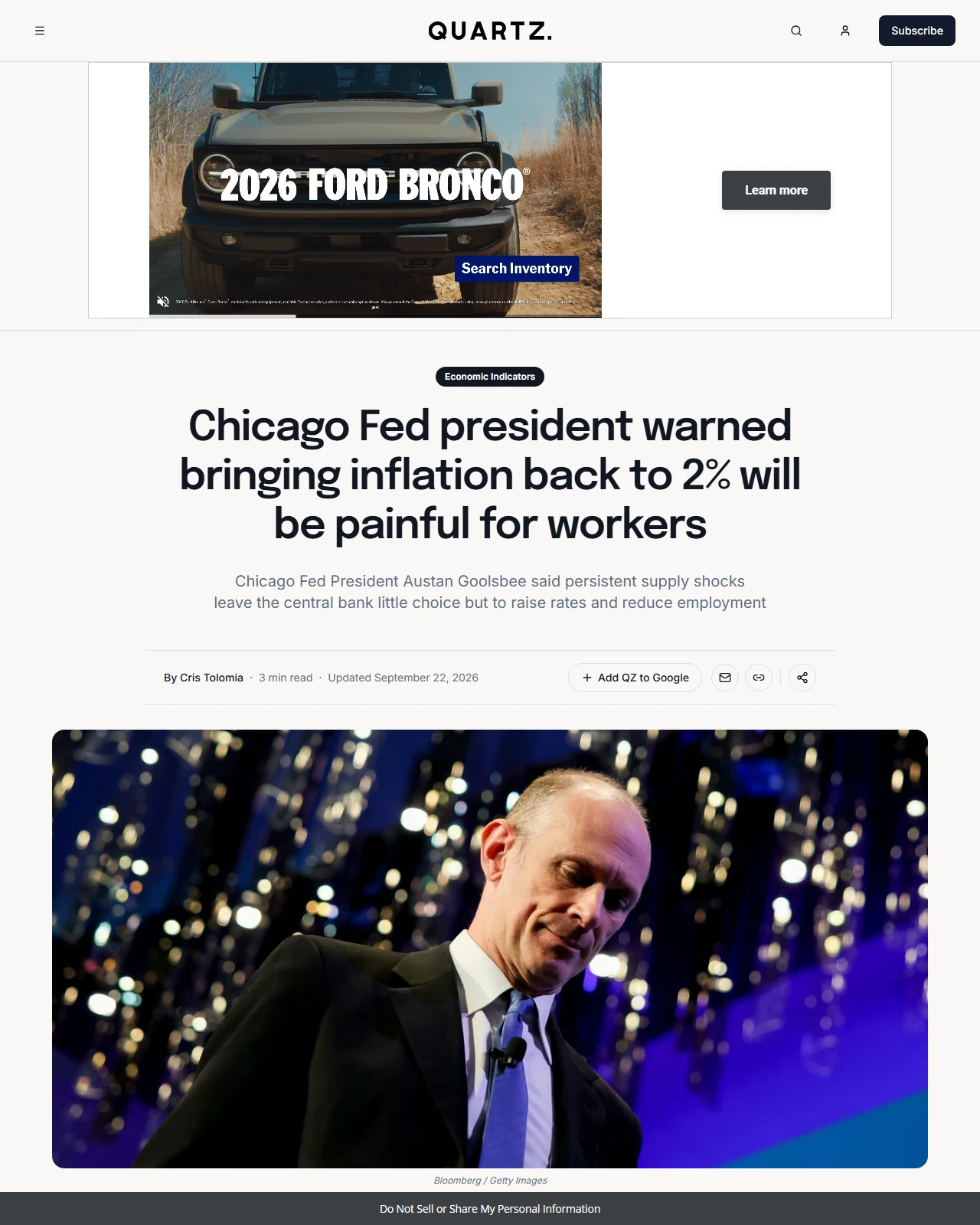
- qz.comAustan Goolsbee warns inflation fight will hurt jobsScreenshot as publishedOriginalcaptured 2026-09-22T16:51:52
Carried by multiple outlets
- Austan Goolsbee is Federal Reserve Bank of Chicago Presidentqz.com, boereport.com
- Goolsbee spoke about the path to 2% inflation involving economic pain or painful tradeoffsbloomberg.com, qz.com
- Goolsbee addressed the role of strong demand or supply shocks in inflationreuters.com, qz.com
Reported by one outlet only
- Goolsbee spoke at an event in Londononly qz.com
- Goolsbee argued that oil prices hovering near $100 a barrel following the war in Iran and repeated tariff escalations constitute sustained supply shocks that can no longer be dismissed as temporaryonly qz.com
- Goolsbee stated 'It's going to be painful. It would necessarily be painful' to reporters after his speechonly qz.com
- Goolsbee said the only way back to 2% inflation is 'the hard way'only qz.com
- Goolsbee's position puts him at odds with Fed Chairman Kevin Warshonly qz.com
- Goolsbee stated: 'This is exactly the painful trade-off between employment and inflation that stagflationary shocks always impose on a central bank'only qz.com
Not yet confirmed against a primary source
- Confirm the event date: Quartz.com states Goolsbee 'warned Monday' but does not provide an absolute date. The cluster identifier indicates September 22, 2026; if Goolsbee spoke on a different Monday, the articles may cover different events or be misdated.
What was checked, and against what
Nothing here could be settled from a primary source. 1 cannot be established from public sources and is listed below. Every document is linked so you can read the same record we did. Anything not confirmed is listed as such rather than left out.
- cannot be established The cluster identifier indicates September 22, 2026; if Goolsbee spoke on a different Monday, the articles may cover different events or be misdated.The disagreement between outlets is itself the finding. No primary source is needed to report that they differ.