



What this entry found
- THE SAME WORDS, PRINTED DIFFERENTLY
3 outlets quote this line 3 different ways.
- npr.org: “The interesting question is not whether we will keep breaking heat records (we will), but whether we're going to do anything about it or just stand there while the climate train runs us over.”
- nypost.com: “The interesting question is not whether we will keep breaking heat records (we will), but whether we’re going to do anything about it or just stand there while the climate train runs us over.”
- timeslive.co.za: “The interesting question is not whether we will keep breaking heat records (we will), but whether we’re going to do anything about it or stand there while the climate train runs us over.”
- ONE SOURCE, MANY MASTHEADS
13 outlets carried this. They resolve to 12 independent sources.
A reader sampling these outlets received 12 accounts, not 13.
Scientists from the European Union's Copernicus Climate Change Service reported that August 2026 was Earth's hottest month on record (or joint-hottest, tying with July 2023, depending on source). Global temperatures averaged 1.65°C above pre-industrial levels, exceeding the 1.5°C Paris Agreement threshold. The heat surge is attributed to human-caused climate change combined with a strong El Niño effect.
9 of 13 articles were readable. Headline only, no body text retrieved, for: itv.com, lufkindailynews.com, news.sky.com, reuters.com. Nothing below is drawn from those outlets beyond their headline.
Who reported it
- apnews.comWIRE
- lufkindailynews.comUNCLASSIFIED
- npr.orgPUBLIC
- nypost.comINDEP
- timeslive.co.zaUNCLASSIFIED
- reuters.comWIRE
- bbc.co.ukPUBLIC
- independent.co.ukINDEP
- itv.comUNCLASSIFIED
- news.sky.comINDEP
- rte.iePUBLIC
- standard.co.ukINDEP
- straitstimes.comINDEP
References
- apnews.comScientists say August was Earth’s hottest month they’ve measuredScreenshot as publishedOriginalcaptured 2026-09-10T11:49:22
- lufkindailynews.comScientists say August 2026 was Earth's hottest month they've measuredScreenshot as publishedOriginalcaptured 2026-09-10T11:49:22
- npr.orgScientists say August was Earth's hottest month they've measuredScreenshot as publishedOriginalcaptured 2026-09-10T11:49:22
- nypost.comAugust was Earth’s hottest month on record, scientists sayScreenshot as publishedOriginalcaptured 2026-09-10T11:49:22
- timeslive.co.zaScientists say August was Earth’s hottest month on recordScreenshot as publishedOriginalcaptured 2026-09-10T11:49:22
- reuters.comAugust was world's joint-hottest month on record, scientists sayScreenshot as publishedOriginalcaptured 2026-09-10T11:49:22
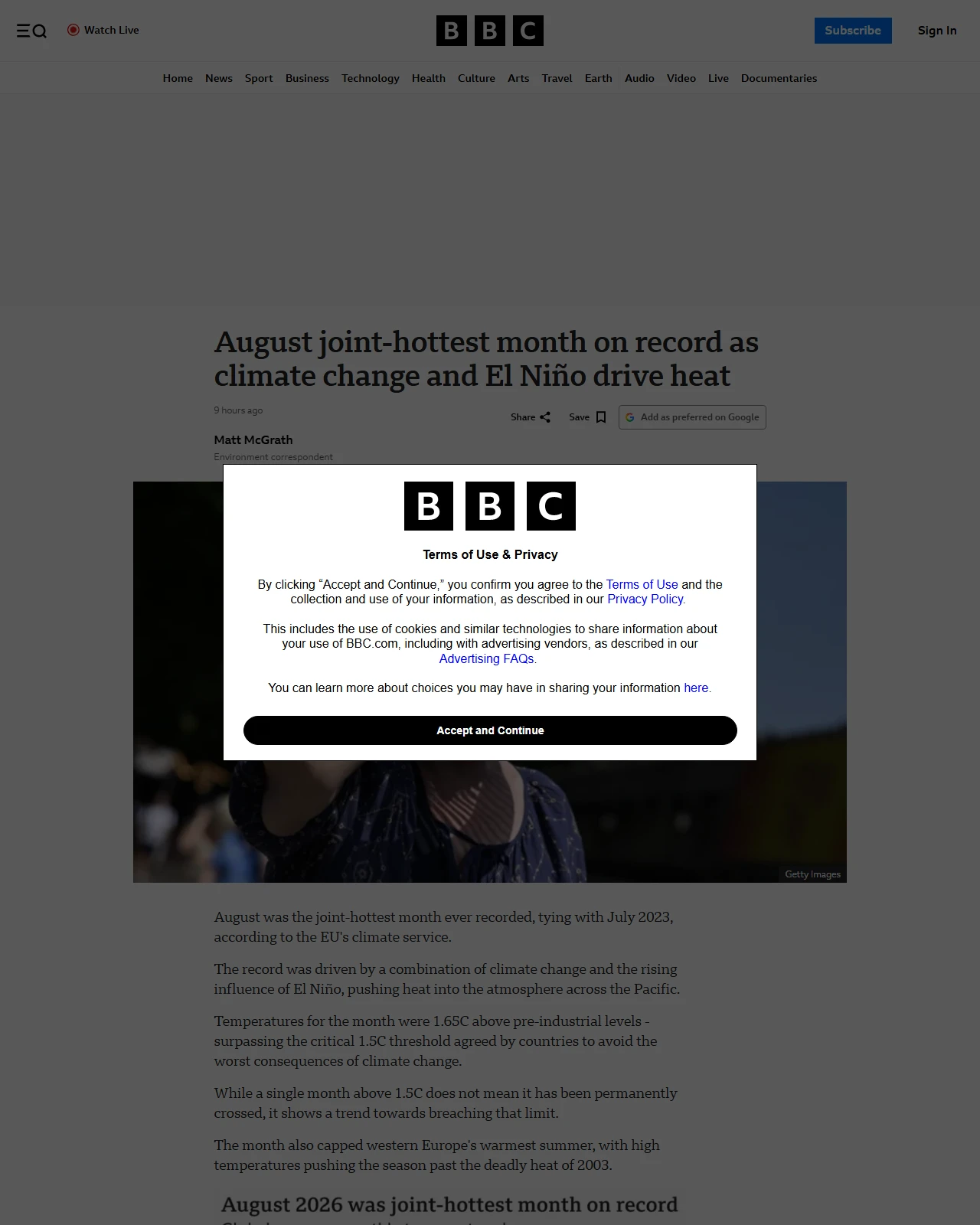
- bbc.co.ukAugust joint-hottest month on record as climate change and El Niño drive heatScreenshot as publishedOriginalcaptured 2026-09-10T11:49:22
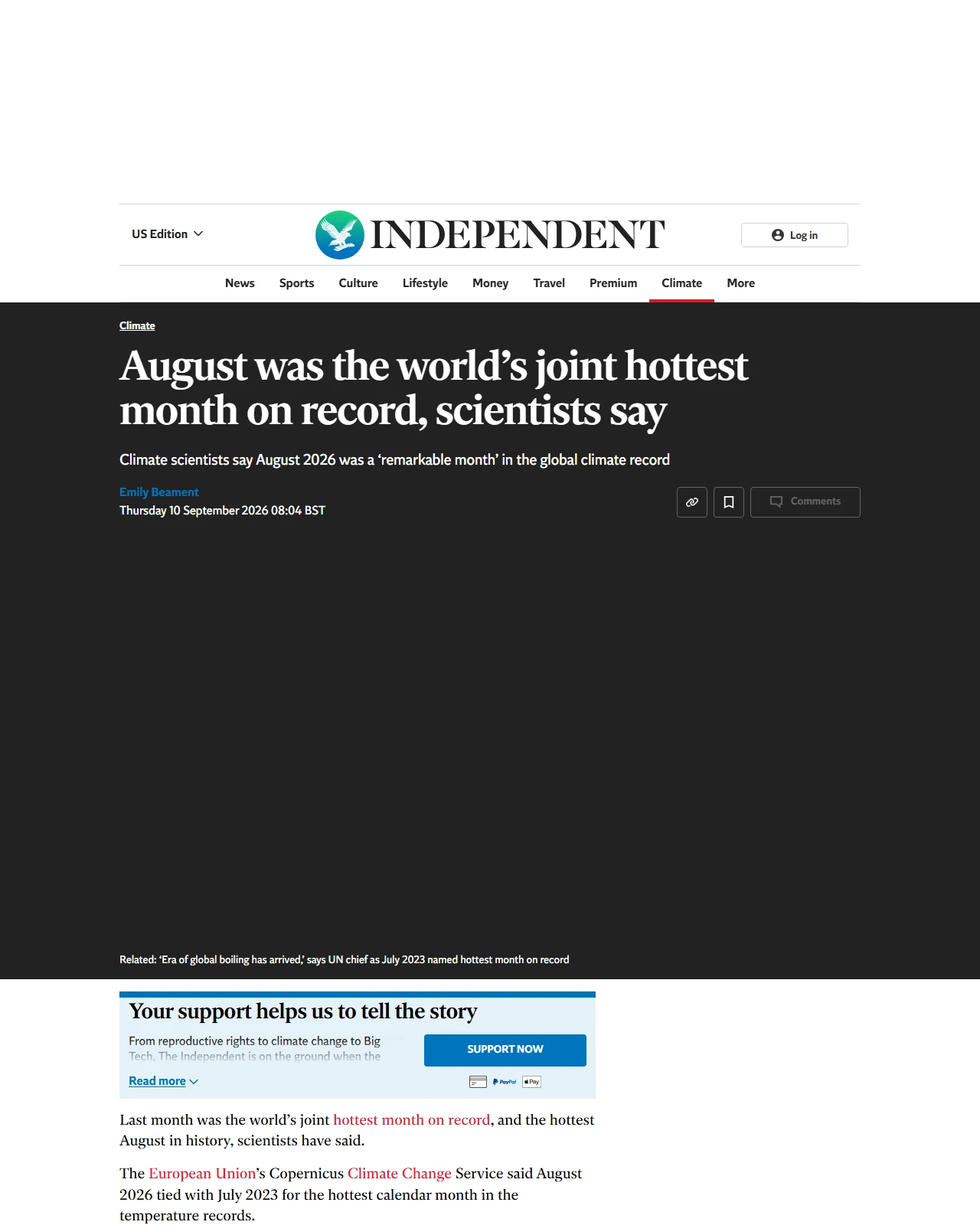
- independent.co.ukAugust was the world’s joint hottest month on record, scientists sayScreenshot as publishedOriginalcaptured 2026-09-10T11:49:22
- itv.comAugust was world’s joint hottest month on record, scientists sayOriginalNo durable copy — do not citecaptured 2026-09-10T11:49:22
- news.sky.comAugust was world's joint hottest month on record, say scientistsScreenshot as publishedOriginalcaptured 2026-09-10T11:49:22
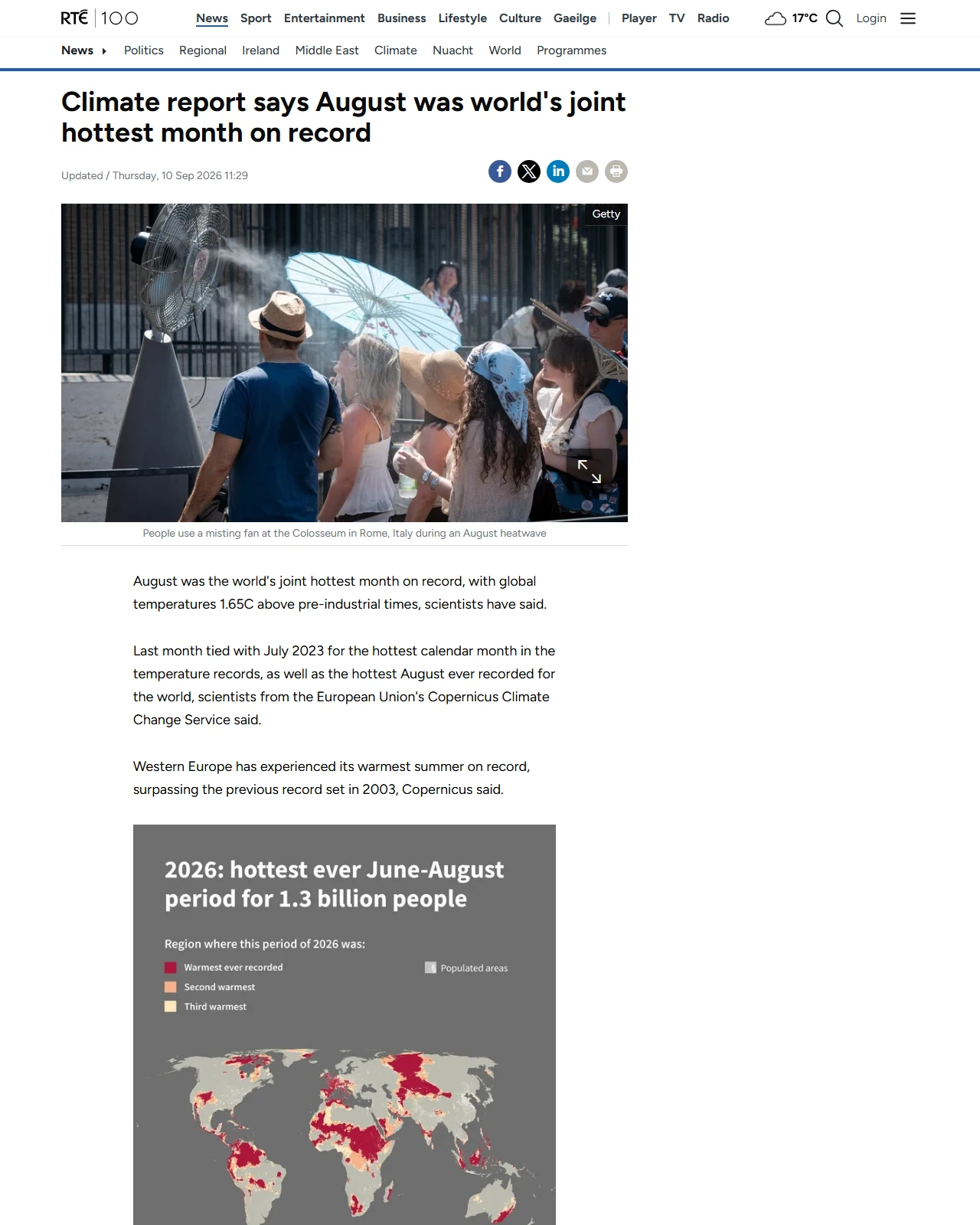
- rte.ieAugust world's joint hottest month on recordScreenshot as publishedOriginalcaptured 2026-09-10T11:49:22
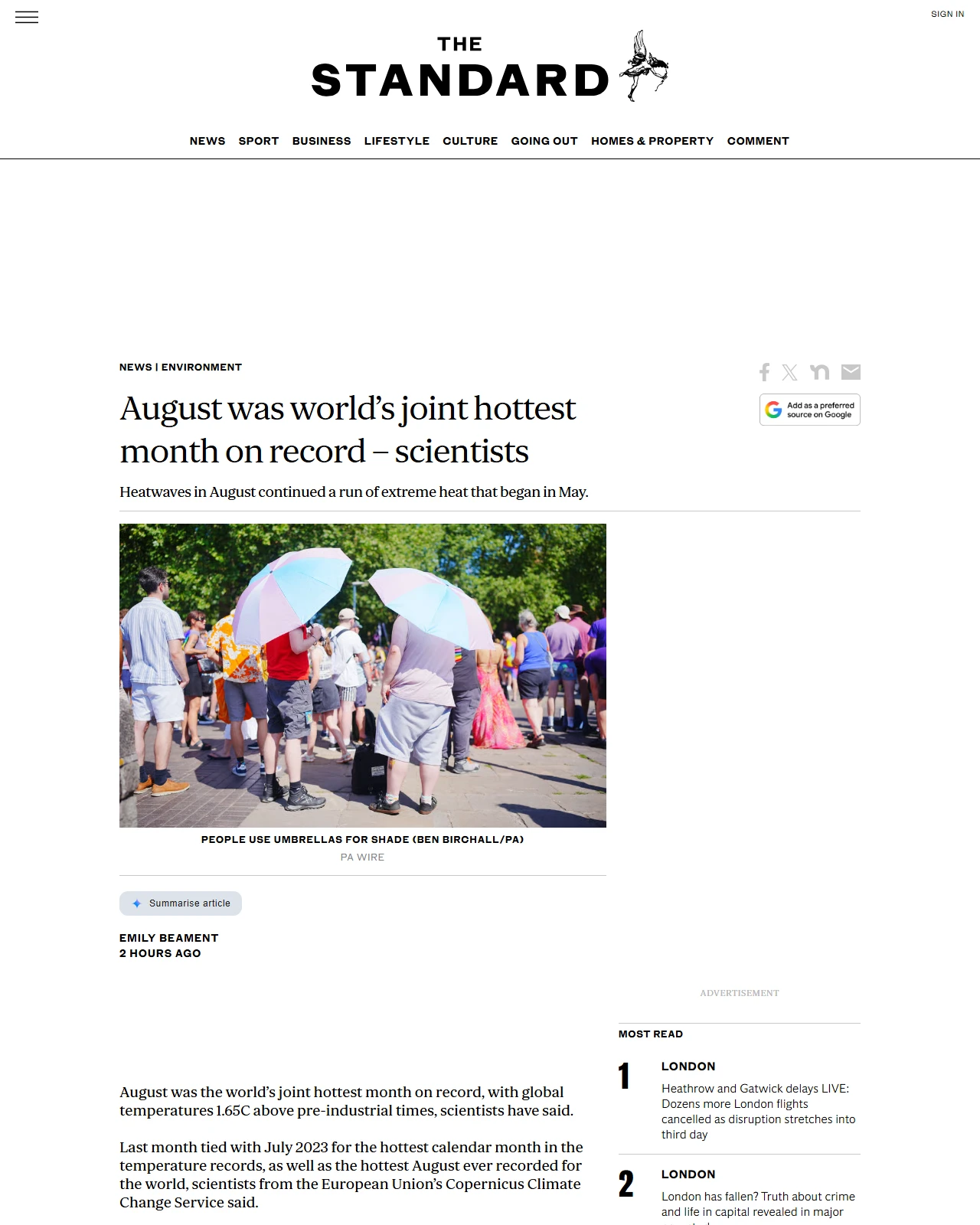
- standard.co.ukAugust was world’s joint hottest month on record – scientistsScreenshot as publishedOriginalcaptured 2026-09-10T11:49:22
- straitstimes.comAugust was world’s joint-hottest month on record, scientists sayScreenshot as publishedOriginalcaptured 2026-09-10T11:49:22
Carried by multiple outlets
- August 2026 was Earth's hottest month on record or joint-hottest month, according to the European Union's Copernicus Climate Change Serviceapnews.com, npr.org, nypost.com, timeslive.co.za, bbc.co.uk, independent.co.uk, rte.ie, standard.co.uk, straitstimes.com
- August 2026 tied with July 2023 for the hottest calendar month on recordbbc.co.uk, independent.co.uk, rte.ie, standard.co.uk, straitstimes.com
- Global temperatures in August were 1.65°C above pre-industrial levels (1850-1900 baseline)npr.org, nypost.com, timeslive.co.za, bbc.co.uk, independent.co.uk, rte.ie, standard.co.uk, straitstimes.com
- The heat surge is attributed to human-caused climate change and a strong El Niñoapnews.com, npr.org, nypost.com, timeslive.co.za, bbc.co.uk, independent.co.uk, standard.co.uk
- August's temperature exceeded the 1.5°C Paris Agreement thresholdnpr.org, nypost.com, bbc.co.uk, independent.co.uk, rte.ie, standard.co.uk, straitstimes.com
- Western Europe experienced its warmest summer on record in 2026, surpassing 2003bbc.co.uk, independent.co.uk, rte.ie, standard.co.uk
- and 3 more, not shown
Reported by one outlet only
- The world averaged 62.53 degrees Fahrenheit (16.96 degrees Celsius) in August, which was one-hundredth of a degree Celsius more than July 2023's mark, but within the uncertainty level and considered a tieonly npr.org
- August also helped push the globe and the United States to experience the hottest Northern Hemisphere summer scientists have measuredonly npr.org
- According to Copernicus, August marked a return to temperatures above 1.5°C for the first time since November 2025only independent.co.uk
- According to Copernicus, August marked the first time temperatures breached 1.5°C since November 2025only rte.ie
- Sea surface temperatures reached record highs in August as a result of global heating and rapidly warming seas in the Pacific associated with El Niñoonly standard.co.uk
- Severe drought conditions in August affected the UK, France, Hungary, Romania, and Serbia, with major rivers like the Rhine, Danube, and Dnieper experiencing exceptionally low flowsonly independent.co.uk
Reported unevenly
- Whether August was definitively the hottest month or joint-hottest month on recordstated by apnews.com (headline: 'hottest month') · absent from bbc.co.uk, independent.co.uk, itv.com, news.sky.com, rte.ie, standard.co.uk, straitstimes.com, reuters.com (all use 'joint-hottest')