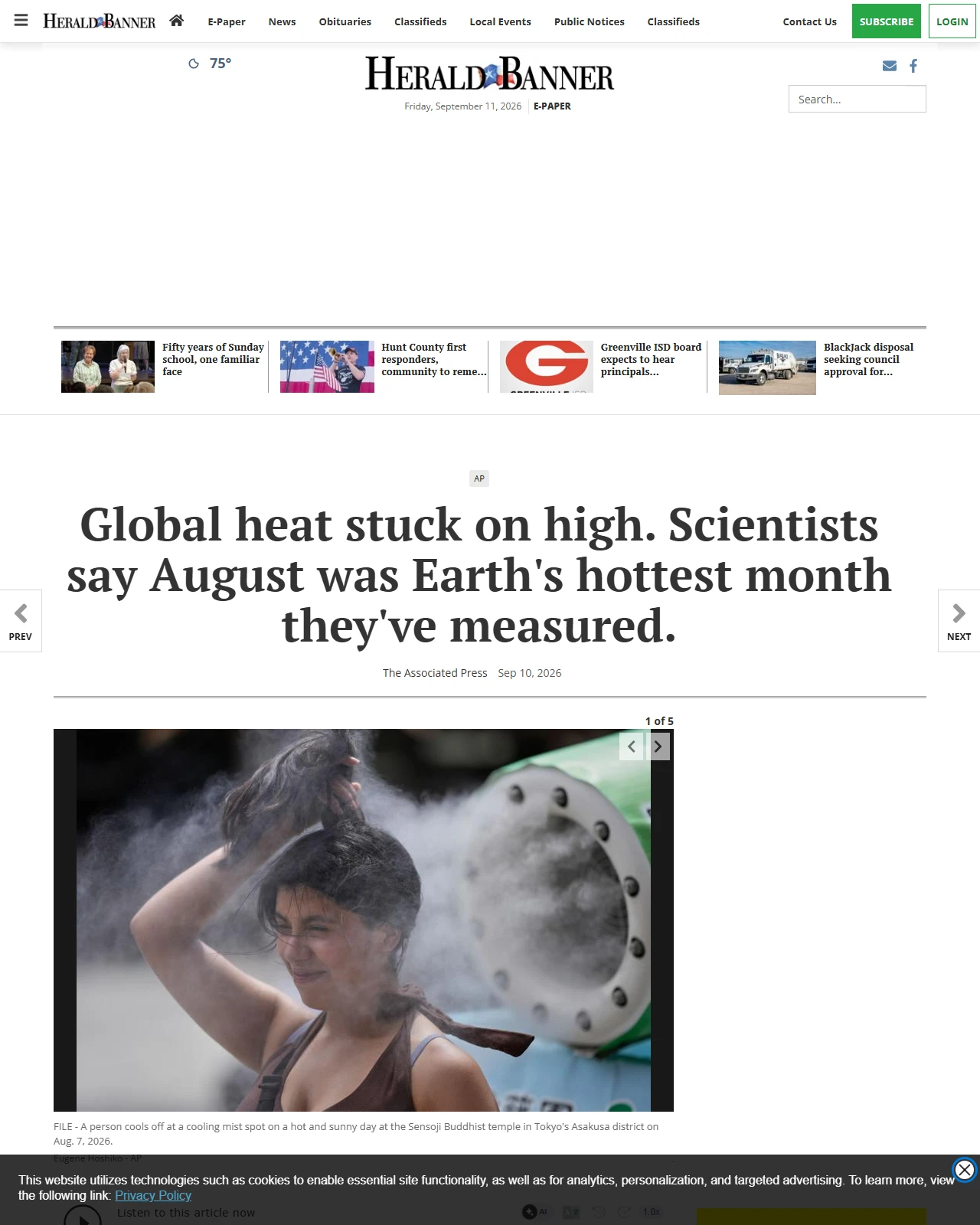
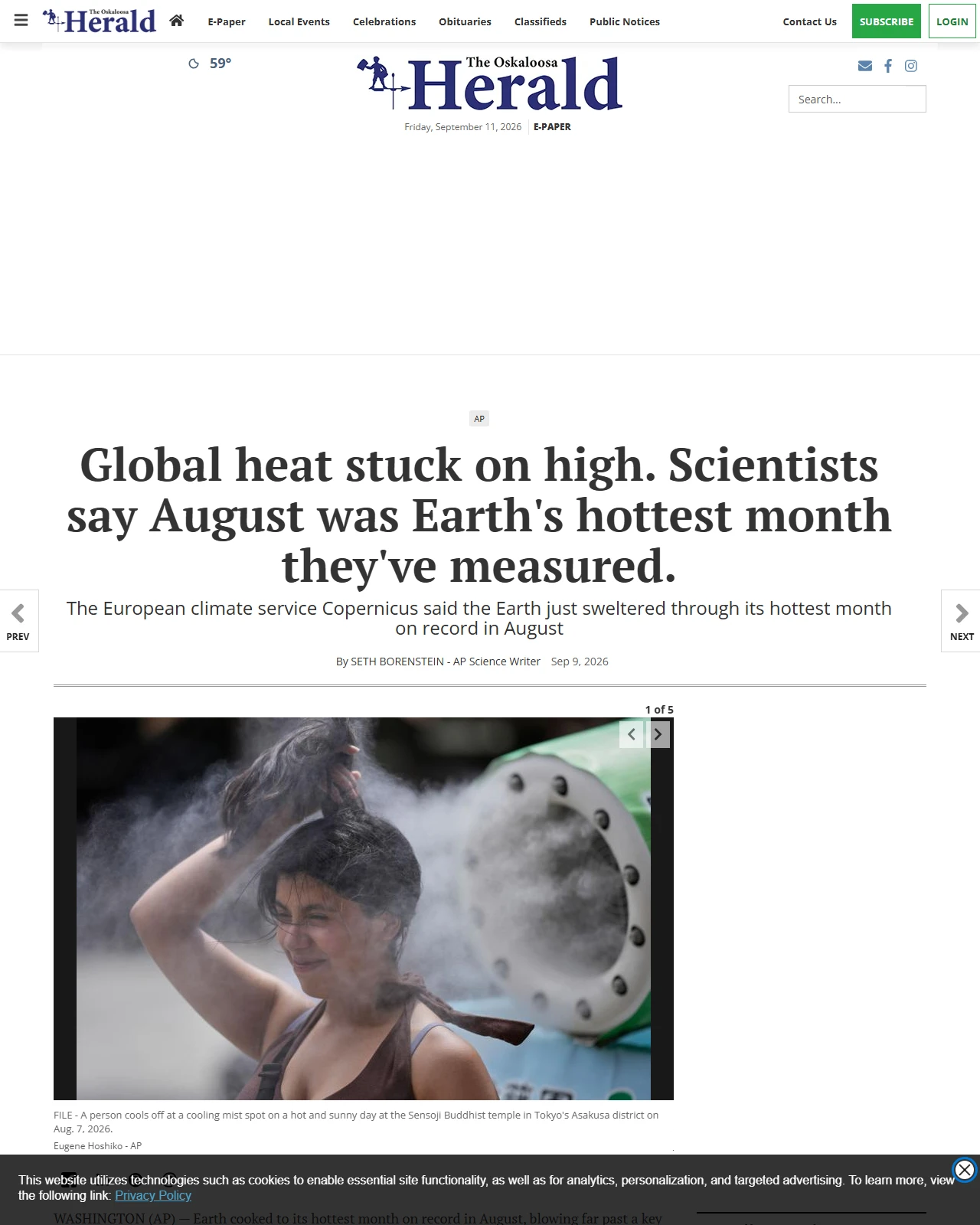

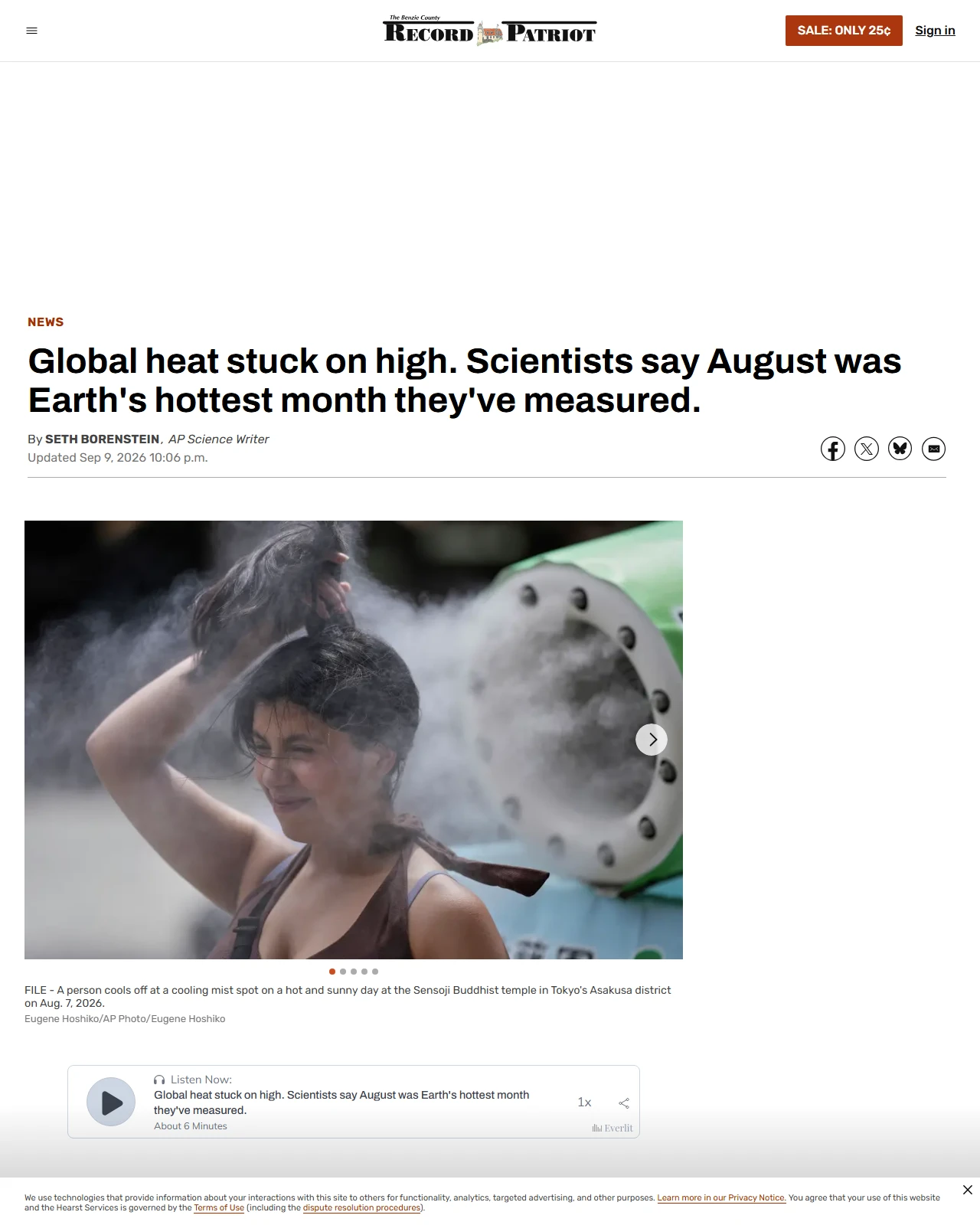

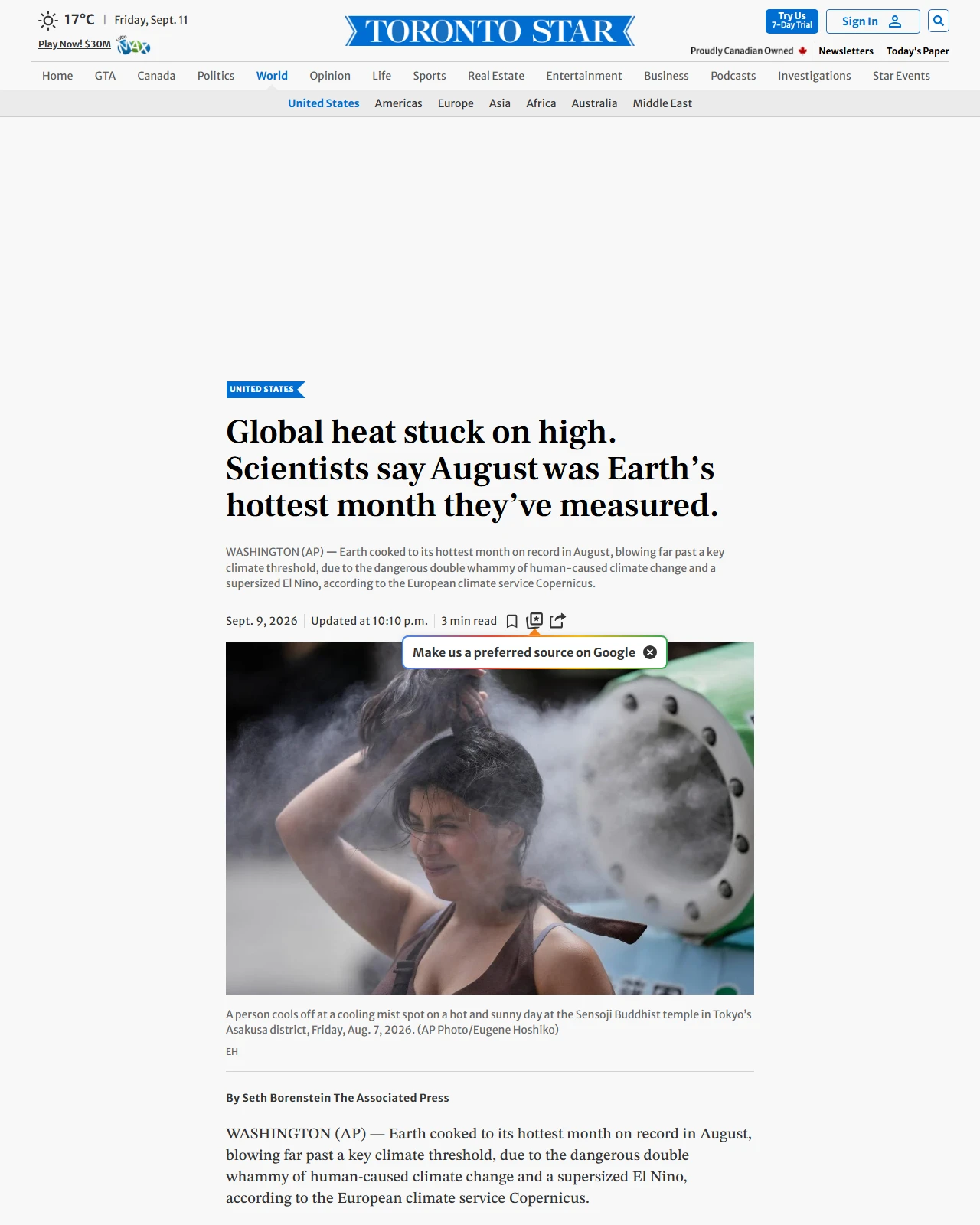
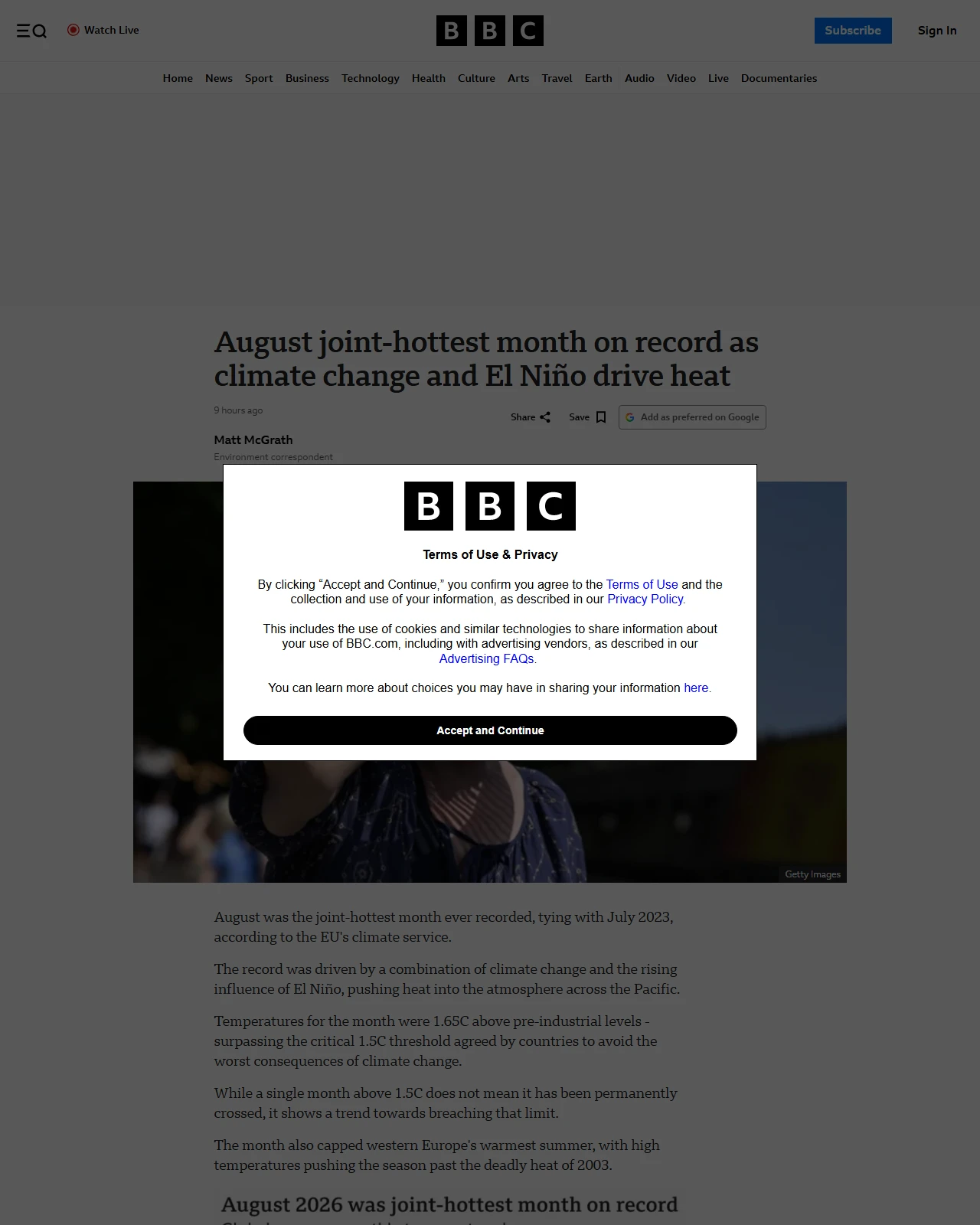
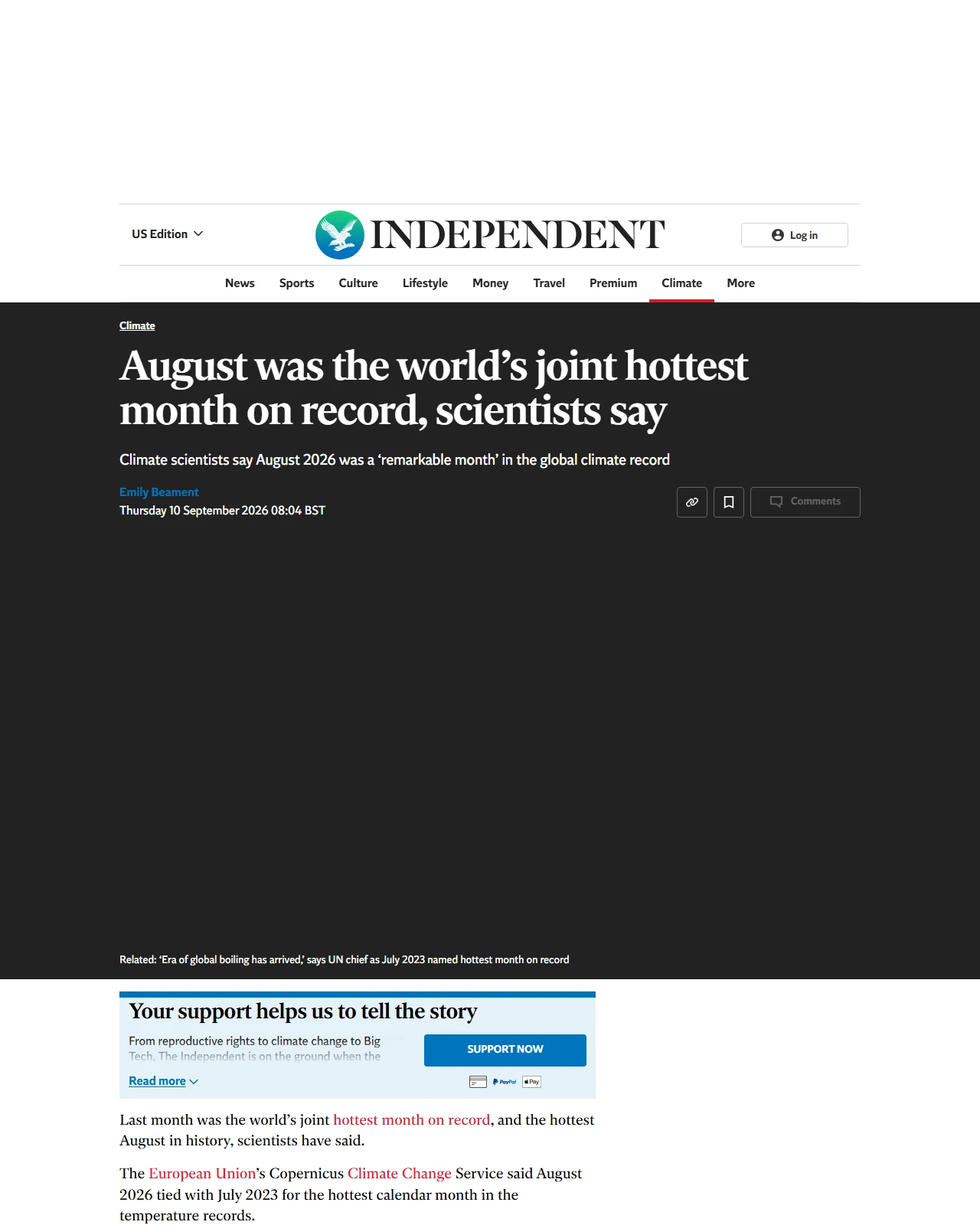

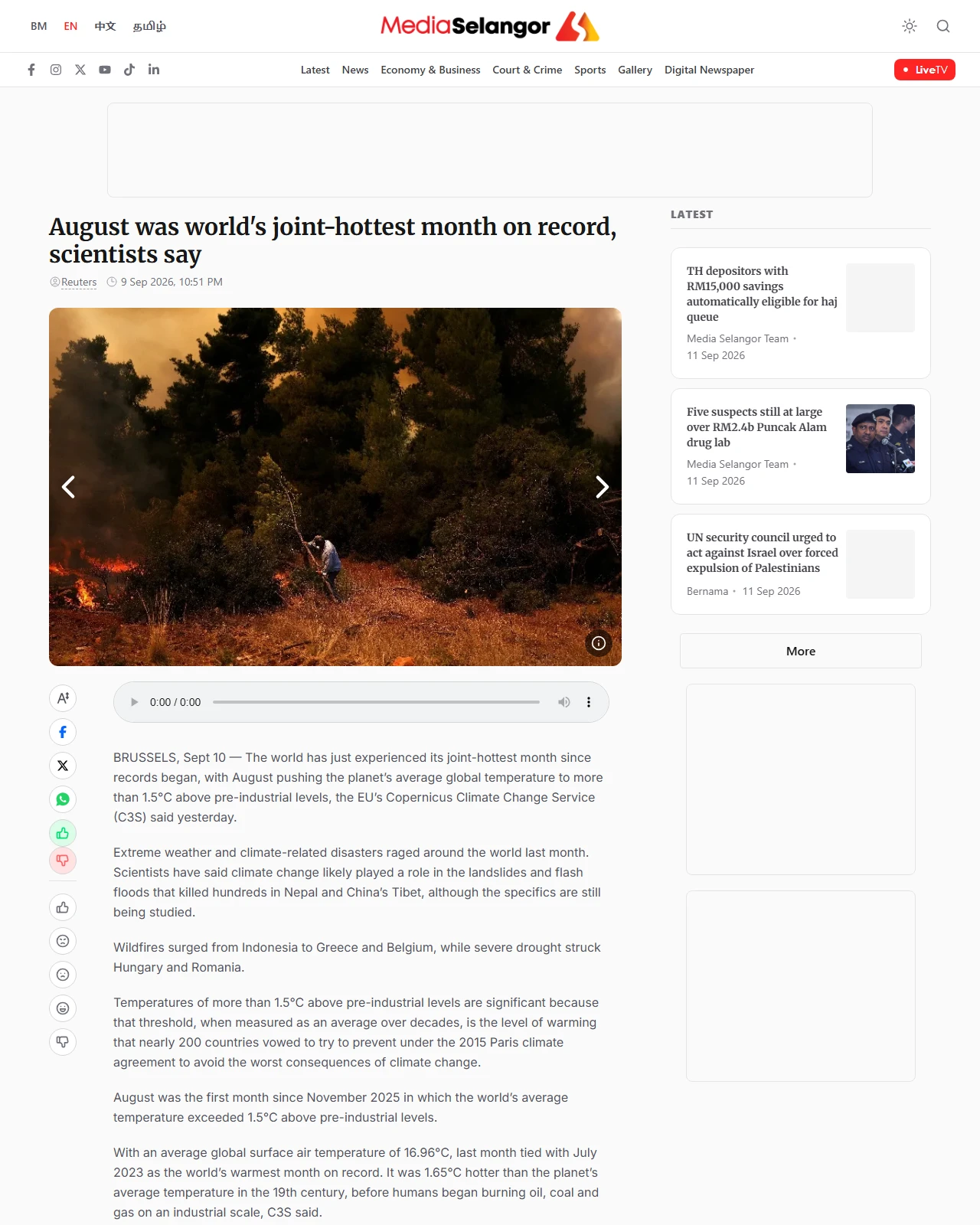
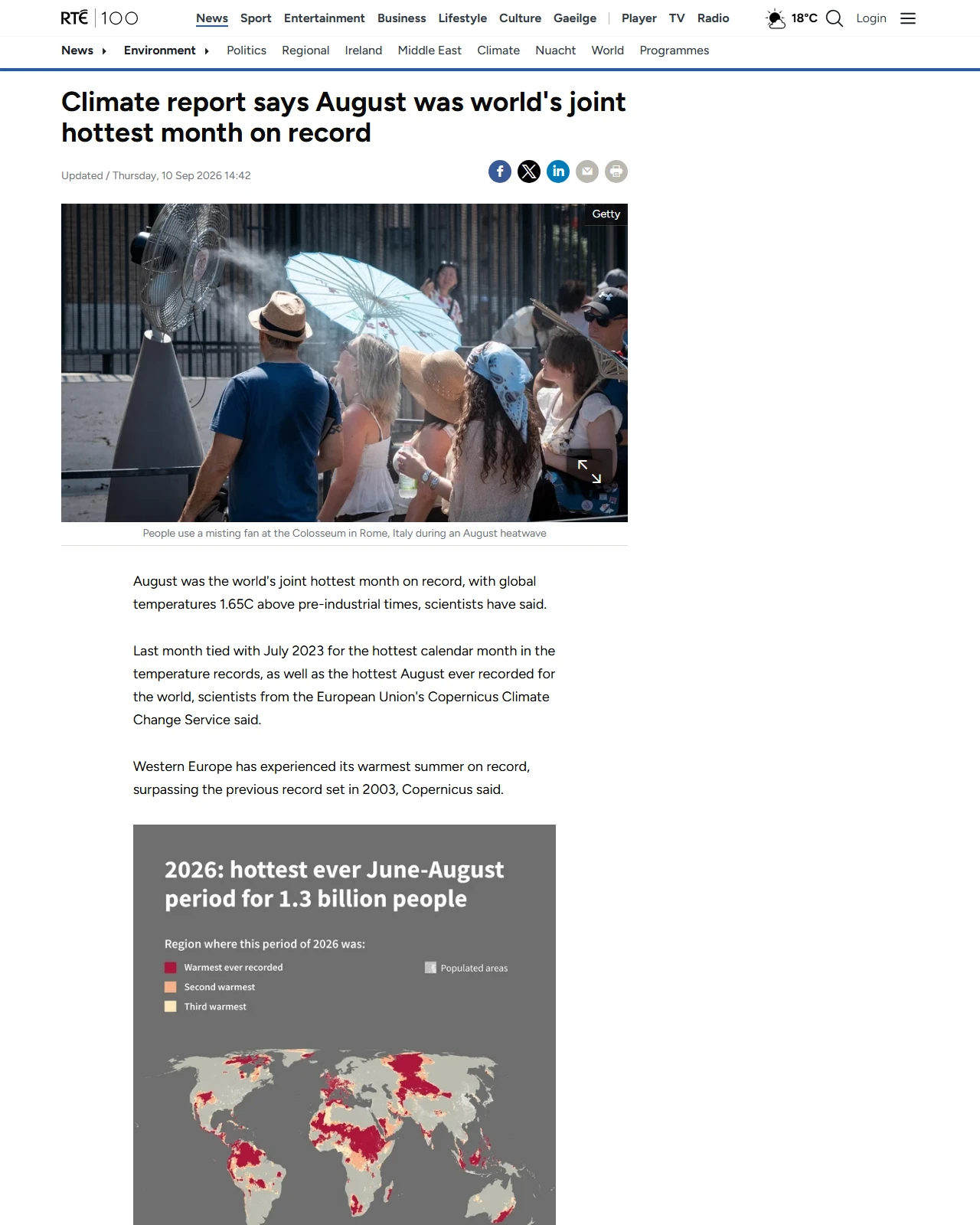
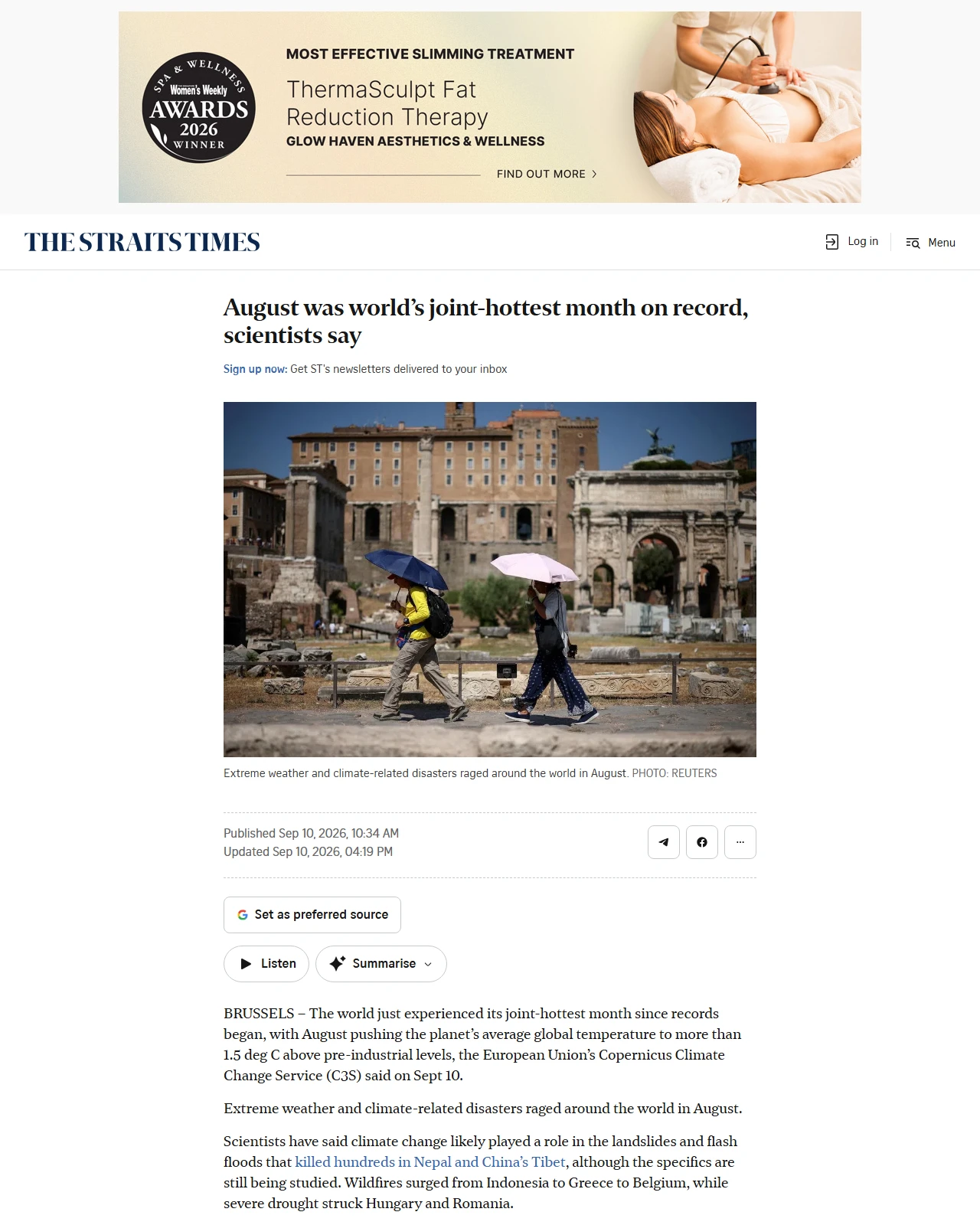
August 2026 was Earth's joint-hottest month on record, tying with July 2023, according to the EU's Copernicus Climate Change Service. Global temperatures were 1.65°C above pre-industrial levels, surpassing the 1.5°C threshold agreed under the 2015 Paris climate agreement. Western Europe experienced its warmest summer on record, and extreme weather including heatwaves, wildfires, droughts, and floods affected multiple regions globally.
10 of 14 articles were readable. Headline only, no body text retrieved, for: heraldbanner.com, itv.com, phys.org, reuters.com. Nothing below is drawn from those outlets beyond their headline.
Who reported it
- heraldbanner.comUNCLASSIFIED
- independent.co.ukINDEP
- oskaloosa.comUNCLASSIFIED
- phys.orgUNCLASSIFIED
- recordpatriot.comUNCLASSIFIED
- seattletimes.comUNCLASSIFIED
- thestar.comINDEP
- reuters.comWIRE
- bbc.co.ukPUBLIC
- independent.co.ukINDEP
- itv.comUNCLASSIFIED
- mediaselangor.comUNCLASSIFIED
- rte.iePUBLIC
- straitstimes.comINDEP
References
- heraldbanner.comGlobal heat stuck on high. Scientists say August was Earth's hottest month they've measured.Screenshot as publishedOriginalcaptured 2026-09-11T11:31:37
- independent.co.ukGlobal heat stuck on high. Scientists say August was Earth's hottest month they've measured.Screenshot as publishedOriginalcaptured 2026-09-11T11:31:37
- oskaloosa.comGlobal heat stuck on high. Scientists say August was Earth's hottest month they've measured.Screenshot as publishedOriginalcaptured 2026-09-11T11:31:37
- phys.orgGlobal heat stuck on high. Scientists say August was Earth's hottest month they've measured.Screenshot as publishedOriginalcaptured 2026-09-11T11:31:37
- recordpatriot.comGlobal heat stuck on high. Scientists say August was Earth's hottest month they've measured.Screenshot as publishedOriginalcaptured 2026-09-11T11:31:37
- seattletimes.comGlobal heat stuck on high. Scientists say August was Earth’s hottest month they’ve measured.Screenshot as publishedOriginalcaptured 2026-09-11T11:31:37
- thestar.comGlobal heat stuck on high. Scientists say August was Earth's hottest month they've measured.Screenshot as publishedOriginalcaptured 2026-09-11T11:31:37
- reuters.comAugust was world's joint-hottest month on record, scientists sayScreenshot as publishedOriginalcaptured 2026-09-10T11:49:22
- bbc.co.ukAugust joint-hottest month on record as climate change and El Niño drive heatScreenshot as publishedOriginalcaptured 2026-09-10T11:49:22
- independent.co.ukAugust was the world’s joint hottest month on record, scientists sayScreenshot as publishedOriginalcaptured 2026-09-10T11:49:22
- itv.comAugust was world’s joint hottest month on record, scientists sayScreenshot as publishedOriginalcaptured 2026-09-11T11:31:37
- mediaselangor.comAugust was world's joint-hottest month on record, scientists sayScreenshot as publishedOriginalcaptured 2026-09-11T11:31:37
- rte.ieAugust world's joint hottest month on recordScreenshot as publishedOriginalcaptured 2026-09-11T11:31:37
- straitstimes.comAugust was world’s joint-hottest month on record, scientists sayScreenshot as publishedOriginalcaptured 2026-09-10T11:49:22
Carried by multiple outlets
- August 2026 was the world's joint-hottest month on record, tying with July 2023.independent.co.uk, bbc.co.uk, rte.ie, mediaselangor.com, straitstimes.com, seattletimes.com, thestar.com, recordpatriot.com
- August 2026 was the hottest August ever recorded.independent.co.uk, rte.ie
- Global temperatures in August were 1.65°C above pre-industrial levels (1850-1900 or 19th century average).independent.co.uk, bbc.co.uk, rte.ie, mediaselangor.com, straitstimes.com, seattletimes.com, thestar.com, recordpatriot.com
- August temperatures exceeded the 1.5°C threshold above pre-industrial levels.independent.co.uk, bbc.co.uk, rte.ie, mediaselangor.com, straitstimes.com, seattletimes.com, thestar.com, recordpatriot.com
- Western Europe experienced its warmest summer on record, surpassing the previous record set in 2003.independent.co.uk, bbc.co.uk, rte.ie
- The data comes from the European Union's Copernicus Climate Change Service.independent.co.uk, bbc.co.uk, rte.ie, mediaselangor.com, straitstimes.com, seattletimes.com, thestar.com, recordpatriot.com
- and 6 more, not shown
Reported by one outlet only
- August 2026 marked a return to temperatures above the 1.5°C threshold, the first time they have breached the figure since November 2025.only independent.co.uk, rte.ie
- The world averaged 62.53 degrees Fahrenheit (16.96 degrees Celsius) in August, which technically was one-hundredth of a degree Celsius more than July 2023, but is considered a tie due to the uncertainty level.only seattletimes.com, thestar.com, recordpatriot.com
- Texas A&M University climate scientist Andrew Dessler stated: 'It is now time to stop acting surprised that our warming planet keeps getting warmer. This is occurring exactly as forecast by scientists literally decades ago,' and questioned whether humanity will break heat records or 'just stand there while the climate train runs us over.'only seattletimes.com, thestar.com, recordpatriot.com
- Scientists have said climate change likely played a role in the landslides and flash floods that killed hundreds in Nepal and China's Tibet, although specifics are still being studied.only mediaselangor.com, straitstimes.com
- Wildfires surged from Indonesia to Greece and Belgium in August.only mediaselangor.com, straitstimes.com
- UN climate chief Simon Stiell stated: 'The evidence is irrefutable: this is the spiralling price of humanity's fossil fuel addiction, and the global climate crisis it is fuelling.'only bbc.co.uk
Reported unevenly
- Whether August 2026 temperatures breached the 1.5°C threshold permanently or temporarily.stated by bbc.co.uk
Not yet confirmed against a primary source
- Copernicus Climate Change Service announcement date: mediaselangor.com and straitstimes.com state 'Sept 10' (or September 10); independent.co.uk, bbc.co.uk, and rte.ie do not state the announcement date explicitly. Confirm whether the Copernicus statement was released on 10 September 2026.
- Whether August 2026 global temperatures were '1.65°C above pre-industrial levels' is consistently reported but pre-industrial baseline differs slightly in phrasing across outlets (some say '1850-1900', others say '19th century'). Confirm Copernicus's exact baseline description.
What was checked, and against what
Nothing here could be settled from a primary source. 2 cannot be established from public sources and are listed below. Every document is linked so you can read the same record we did. Anything not confirmed is listed as such rather than left out.
- cannot be established Copernicus Climate Change Service announcement date: mediaselangor.com and straitstimes.com state 'Sept 10' (or September 10); independent.co.uk, bbc.co.uk, and rte.ie do not state the announcement date explicitly.The disagreement between outlets is itself the finding. No primary source is needed to report that they differ.
- cannot be established Whether August 2026 global temperatures were '1.65°C above pre-industrial levels' is consistently reported but pre-industrial baseline differs slightly in phrasing across outlets (some say '1850-1900', others say '19th century').The difference does not bear on anything this entry claims. It is recorded here so the reader can see it was noticed and set aside deliberately.