


Same storyEarlier: A glacier collapse on the Nepal-Tibet border on 26 August 2026 triggered catastrophic…Earlier: Scientists, including those from World Weather Attribution, assessed a catastrophic rock…Each entry records what was published on its own date and is not edited afterwards.
What this entry found
- OUTLETS DISAGREE
Whether the flood occurred on August 26 or Wednesday
- aljazeera.com states August 26
- dw.com states Wednesday (described as occurring 23 hours before publication)
- ONLY ONE OUTLET HAD THIS
dw.com carried 4 details no other outlet reported.
- Within 10 minutes, enormous volumes of water and debris swept 20 kilometers downstream
- Niels Hovius, head of the Geomorphology Section at the GFZ Helmholtz Centre for Geosciences in Potsdam, said flash floods are more the rule than the exception in the Himalayas
- Seismological instruments recorded an earthquake measuring 4.4 on the Richter scale at the time of the glacier collapse
- Niels Hovius stated the earthquake was not a 'classic' or tectonic earthquake, but rather the force of the falling glacier
5independent outlets
What happened, for context
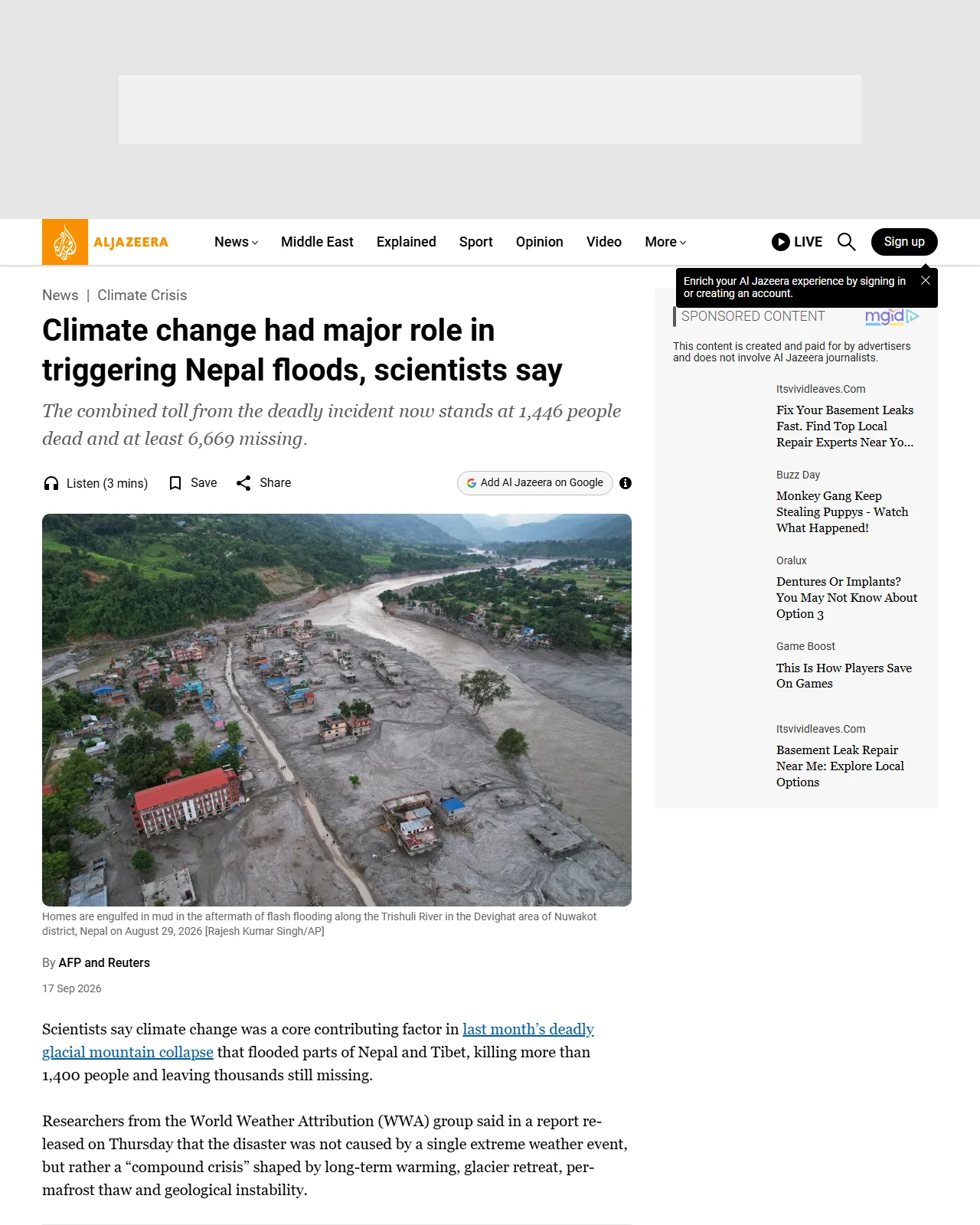
A glacial collapse on Langtang Lirung mountain near the Nepal-China border on August 26, 2026, triggered a flash flood that killed over 1,400 people and left thousands missing. Scientists from the World Weather Attribution group reported that climate change played a core contributing role in the disaster.
2 of 5 articles were readable. Headline only, no body text retrieved, for: climatechangenews.com, euronews.com, nytimes.com. Nothing below is drawn from those outlets beyond their headline.
Who reported it
- aljazeera.comINDEP
- climatechangenews.comUNCLASSIFIED
- dw.comPUBLIC
- euronews.comUNCLASSIFIED
- nytimes.comINDEP
References
- aljazeera.comClimate change had major role in triggering Nepal floods, scientists sayScreenshot as publishedOriginalcaptured 2026-09-18T11:56:11
- climatechangenews.comNepal flood destruction shows "limits to adaptation", scientists sayScreenshot as publishedOriginalcaptured 2026-09-17T12:00:05
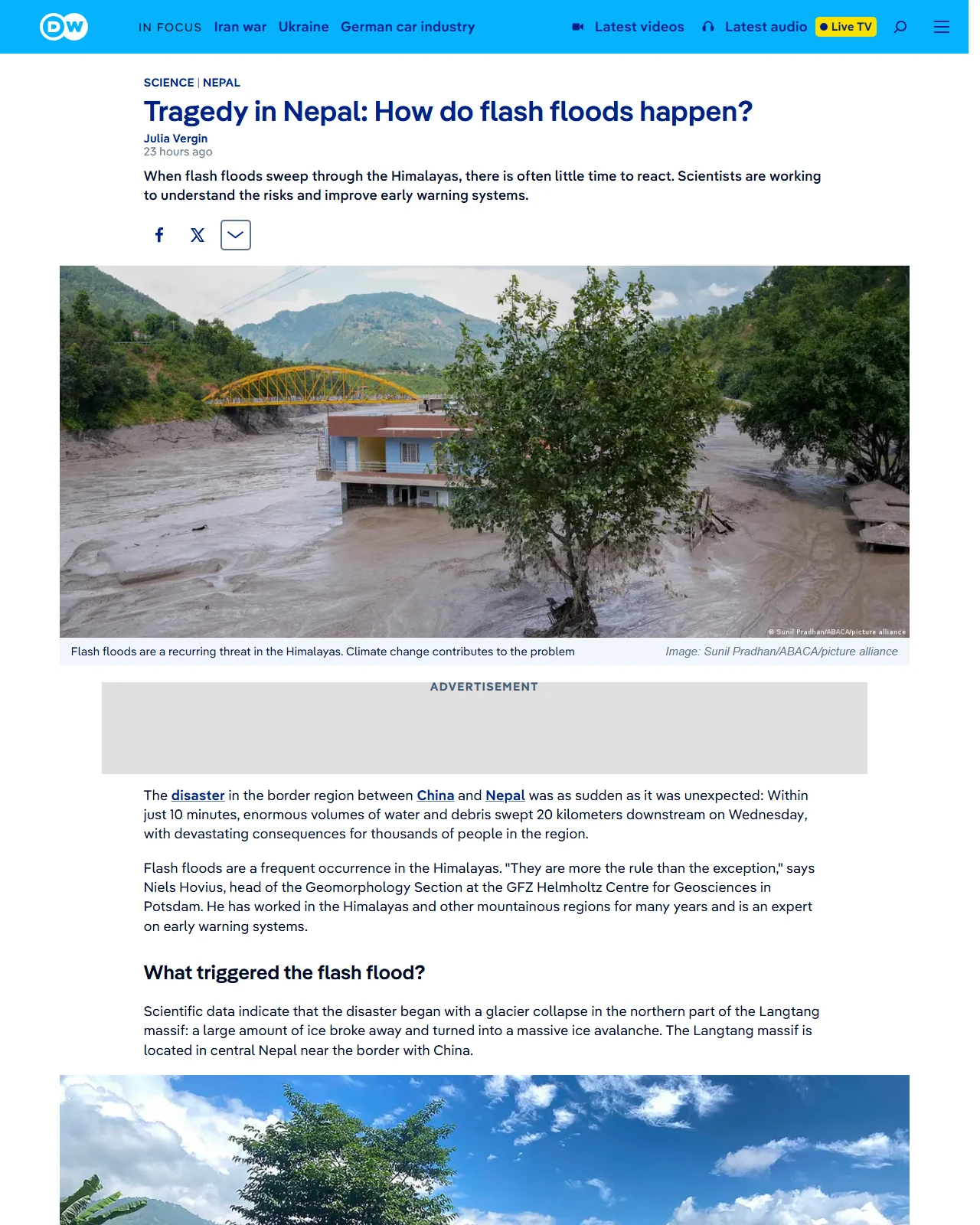
- dw.comTragedy in Nepal: How do flash floods happen?Screenshot as publishedOriginalcaptured 2026-08-28T13:52:04
- euronews.comClimate change was key factor in deadly Nepal-China flood, scientists sayScreenshot as publishedOriginalcaptured 2026-09-17T12:00:05
- nytimes.comScientists Warn of Flood Risks to 8 Himalayan Countries after Nepal DisasterScreenshot as publishedOriginalcaptured 2026-09-18T11:56:11
Carried by multiple outlets
- A glacier collapse occurred on Langtang Lirung mountain on August 26, 2026aljazeera.com, dw.com
- The collapse triggered a flash flood that swept downstream with devastating consequencesaljazeera.com, dw.com
- The flood affected the Nepal-China border regionaljazeera.com, dw.com
- The flood killed more than 1,400 peoplealjazeera.com, dw.com
- Scientists assessed climate change as a contributing factor to the disasteraljazeera.com, euronews.com
Reported by one outlet only
- The combined toll now stands at 1,446 people dead and at least 6,669 missingonly aljazeera.com
- The World Weather Attribution group released a report saying the disaster was a 'compound crisis' shaped by long-term warming, glacier retreat, permafrost thaw and geological instabilityonly aljazeera.com
- Within 10 minutes, enormous volumes of water and debris swept 20 kilometers downstreamonly dw.com
- Niels Hovius, head of the Geomorphology Section at the GFZ Helmholtz Centre for Geosciences in Potsdam, said flash floods are more the rule than the exception in the Himalayasonly dw.com
- Seismological instruments recorded an earthquake measuring 4.4 on the Richter scale at the time of the glacier collapseonly dw.com
- Niels Hovius stated the earthquake was not a 'classic' or tectonic earthquake, but rather the force of the falling glacieronly dw.com
Reported unevenly
- Whether the flood occurred on August 26 or Wednesdaystated by aljazeera.com states August 26, dw.com states Wednesday (described as occurring 23 hours before publication)
Not yet confirmed against a primary source
- Confirm whether August 26 (aljazeera.com) and Wednesday (dw.com, described as 23 hours before its publication) refer to the same date. If dw.com was published on September 19, Wednesday would be September 18, but aljazeera.com states August 26. Clarify whether there is a discrepancy in the event date or whether the dates refer to different aspects of the disaster timeline.